CFDs, or contracts for difference, are financial derivatives settled based on price differences. Because CFDs support leverage and two way trading, they are widely used across stocks, forex, commodities, and cryptocurrency markets.
With the development of online trading platforms and digital asset markets, CFDs have become an important part of the global retail derivatives market. However, compared with traditional spot trading, the risk structure of CFDs is more complex. The leverage mechanism can improve capital efficiency, but it also magnifies the risk of losses caused by price volatility.
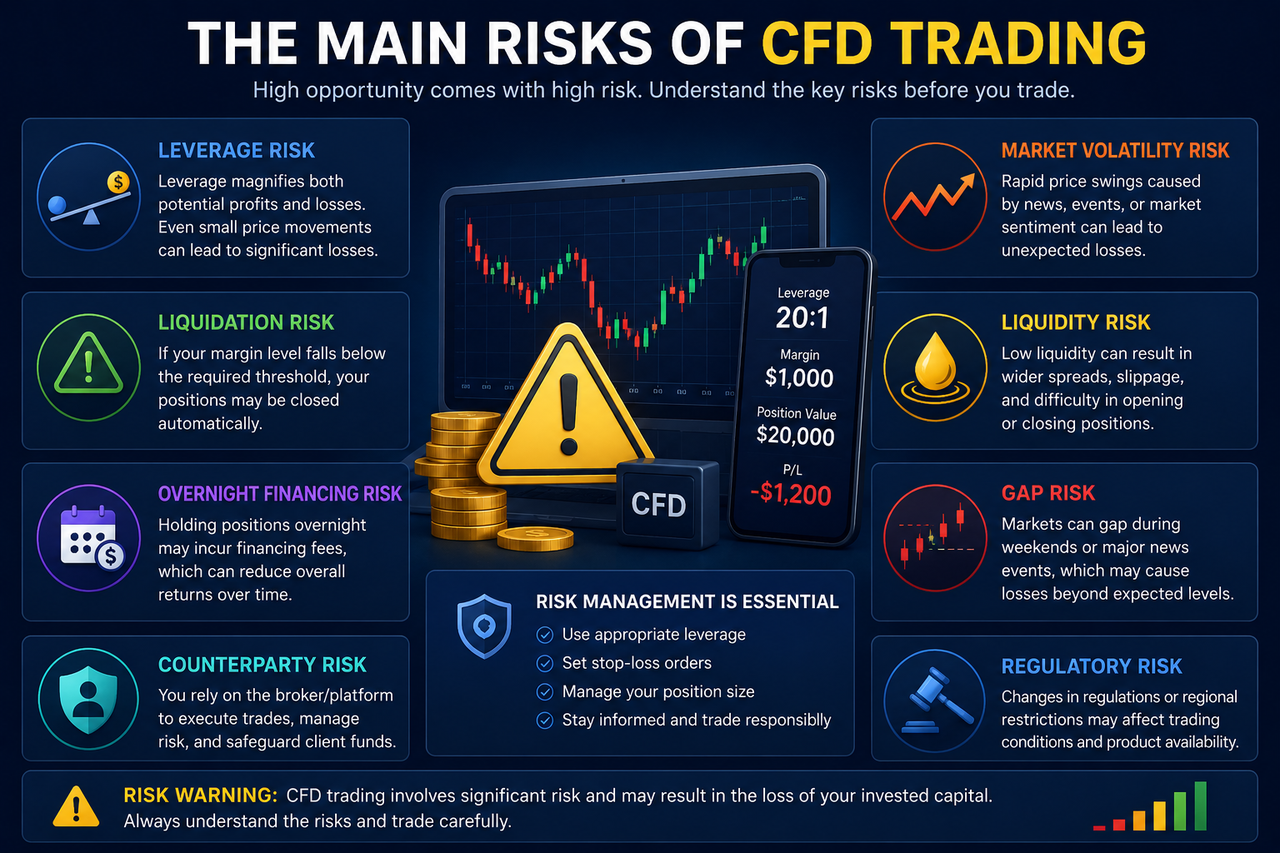
Why Are CFDs Considered High Risk Trading?
CFDs are high risk derivatives, mainly because of their leverage structure.
In CFD trading, users usually only need to pay a portion of the required margin to open a position that is far larger than their account principal. This means even a small movement in market price can have a significant impact on account equity.
For example, with 20x leverage, a market price movement of only 5% could theoretically correspond to a profit or loss equal to the full margin amount.
Although leverage can magnify gains, it also magnifies the risk of losses in the same way.
What Is Leverage Risk?
Leverage risk is one of the core risk types in the CFD market.
Because traders control positions much larger than the actual funds in their accounts, even small market movements can quickly expand account losses.
The relationship between leverage and risk can usually be expressed as:
$${Leverage} = \frac{\text{Position Size}}{\text{Margin}$$
The higher the leverage ratio, the more sensitive the account becomes to market movements.
Under high leverage, even a slight price change may cause account equity to fall rapidly. This is one of the key reasons CFDs are classified as high risk derivatives.
What Is Forced Liquidation Risk?
Forced liquidation is an important part of the CFD risk control system.
When the market moves against a position and account equity falls below the maintenance margin requirement, the platform may automatically close part or all of the position to prevent losses from expanding further.
Liquidation risk is usually related to the following factors:
-
High leverage ratios
-
Rapid market movements
-
Oversized positions
-
Insufficient margin
In highly volatile markets, such as cryptocurrency CFDs or crude oil CFDs, forced liquidation risk is usually more pronounced.
Under extreme market conditions, sharp movements within a short period may even cause the system to liquidate an account automatically before the user has time to add margin.
Why Is Market Volatility Risk Important?
CFDs are, by nature, derivatives traded based on price movements, so market volatility is one of their core sources of risk.
Stock, forex, commodity, and cryptocurrency markets can all be affected by macroeconomic data, interest rate policy, geopolitical events, changes in market sentiment, and shifts in liquidity.
When market volatility rises suddenly, the profits and losses of CFD positions may change rapidly.
This is especially true in the cryptocurrency market. Because crypto markets operate around the clock and are highly volatile, price changes in crypto CFDs are usually much more pronounced than in traditional markets.
Why Do CFDs Have Liquidity Risk?
Liquidity risk refers to the risk that a trade cannot be executed quickly at the expected price.
In a low liquidity market environment, CFD prices may experience wider spreads, increased slippage, unstable quotes, or difficulty closing positions.
This is especially common during major news events or extreme market conditions, when market depth may decline quickly and affect execution efficiency.
Some CFD products rely on broker quotes, so a platform’s liquidity model may also affect price stability.
What Risks Can Overnight Financing Fees Create?
Most CFD products do not have a fixed expiration date, so long term holdings usually incur overnight financing fees.
Overnight fees are essentially related to the use of leveraged capital. When users hold CFD positions over a longer period, financing costs may gradually increase and affect the final trading result.
For high leverage positions, even when market prices do not change much, accumulated financing fees over time may become an important cost.
The CFD market usually relies on brokers or trading platforms to provide quotes and liquidity, so platform risk is another important factor to consider.
Platforms may differ in the following areas:
-
Risk control mechanisms
-
Liquidity sources
-
Leverage limits
-
Liquidation rules
-
Fee structures
CFDs in some markets may also be affected by changes in regulatory policy.
As a result, platform stability, market transparency, and the regulatory environment can all affect the overall risk structure of CFDs.
Why Are Cryptocurrency CFDs Riskier?
Compared with traditional stock or forex CFDs, cryptocurrency CFDs usually carry higher risk. This is because digital assets tend to be more volatile, the market operates 24 hours a day, liquidity changes are more noticeable, forced liquidations occur more frequently, and market sentiment shifts more quickly.
As a result, under extreme market conditions, the crypto market may experience sharp movements within a short period, causing leveraged positions to be liquidated rapidly.
How Are CFD Risks Different from Traditional Spot Trading Risks?
Traditional spot trading usually involves holding real assets, so the scope of losses is generally limited to the capital already invested.
With CFDs, however, the leverage structure magnifies account risk. Traders face not only market price risk, but also margin risk, forced liquidation risk, and financing cost risk.
In addition, CFDs place greater emphasis on short term price movements, so their risk profile can change faster than that of traditional long term asset investments.
Comparison of Core CFD Risk Structures
| Risk Type |
How the Risk Appears in CFDs |
| Leverage risk |
Magnifies gains and losses |
| Liquidation risk |
Automatic position closure when margin is insufficient |
| Volatility risk |
Rapid changes in market prices |
| Liquidity risk |
Wider spreads and slippage |
| Financing risk |
Overnight fees increase holding costs |
| Platform risk |
Differences in quotes and risk control mechanisms |
| Market risk |
Impact from macro conditions and sentiment shifts |
Summary
CFDs are high risk leveraged derivatives. Their risk structure mainly revolves around leverage, market volatility, margin, and liquidity.
Because CFDs can amplify market price changes, even relatively small movements may have a significant impact on account equity. At the same time, forced liquidation, overnight financing fees, and changes in platform liquidity can also affect the final trading result.
FAQs
Why Are CFDs High Risk?
Because CFDs usually use leverage, even small market movements can magnify changes in account profits and losses.
Why Does CFD Forced Liquidation Occur?
When account equity falls below the maintenance margin requirement, the platform may automatically close positions to control risk.
Can CFDs Lead to a Loss of All Principal?
Under high leverage, rapid market movements may cause account funds to shrink sharply, potentially approaching a total loss.
What Are Overnight Financing Fees?
Overnight financing fees are the cost of using capital when holding CFD positions over a longer period.
Why Are Cryptocurrency CFDs Riskier?
Because digital asset markets are more volatile and have longer trading hours, leverage risk is usually more pronounced.
How Is CFD Risk Different from Spot Trading Risk?
Spot trading usually involves only asset price risk, while CFDs also include additional risk structures such as leverage, margin, and forced liquidation.