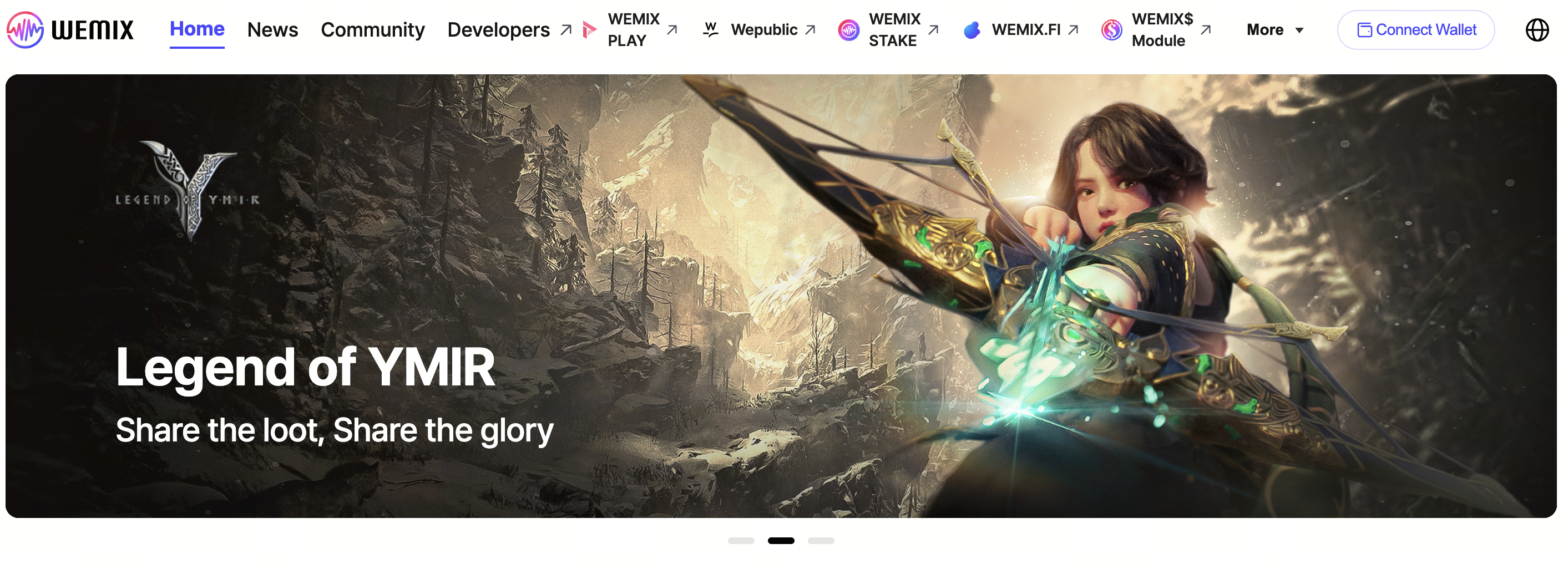
 Image source: WEMIX Official Website
Unlike traditional game tokens, which typically serve only a single title, WEMIX is designed to elevate “blockchain gaming” from isolated efforts to a full-fledged infrastructure suite. On one side, it leverages Korea’s strengths in MMORPGs, IP management, and global publishing; on the other, it directly embeds tokens, NFTs, and DeFi modules into the entire game lifecycle. This fosters a tighter economic closed loop among players, developers, nodes, and the foundation, with on-chain data showing cumulative transaction volume surpassing $11 billion—making WEMIX a flagship public chain for gaming in Asia.
From an industry evolution standpoint, WEMIX exemplifies the “gaming public chain + integrated ecosystem” model: it operates its own public chain as a game publishing platform, anchors settlement with a stablecoin, drives user growth with NFT and token rewards, and relies on node economics and governance for long-term sustainability. This structure not only meets Web3’s demand for “composable assets” and “on-chain economies,” but also integrates traditional gaming KPIs like retention, ARPU, and IP value into on-chain data and tokenomics.
The following sections systematically examine WEMIX through seven lenses: project background, technical architecture, ecosystem design, tokenomics, industry comparisons, risk events, and future roadmap—helping readers build a comprehensive, objective understanding.
What Is WEMIX? Project Background and Development
WEMIX was launched by Korean gaming company Wemade. Founded in February 2000 and headquartered in Seongnam, South Korea, Wemade was established by the original developers of the classic MMORPG “Legend of Mir.” The “Legend of Mir” series has attracted over 120 million users across Asia, with peak monthly revenue exceeding $65 million—solidifying Wemade’s leadership in Korea’s gaming industry.
Building on its strong IP base and publishing expertise, Wemade began systematically expanding into blockchain in 2018, using WEMIX as its umbrella brand. In 2020, it released the WEMIX Wallet, and in 2021, integrated its MMORPG “MIR4” with a blockchain economy—making it one of the first large-scale P2E (Play-to-Earn) games, with global concurrent users peaking at 1.4 million.
In November 2022, Wemade launched its proprietary mainnet, WEMIX3.0, migrating tokens and games from Ethereum and Klaytn to its own chain and building out the “Mega-Ecosystem” vision—covering gaming, DeFi, NFT, stablecoin, and payments. After two delisting incidents on Korean exchanges in 2022 and 2025, WEMIX restored market confidence through token buybacks, ecosystem restructuring, and global expansion from 2025 to 2026.
WEMIX3.0: Core Technical Architecture and Operations
WEMIX3.0 is a fully EVM-compatible Layer 1 public chain, allowing developers to deploy directly with Ethereum tools like Solidity, Hardhat, and Foundry—dramatically reducing migration costs.
-
Performance: WEMIX3.0 targets up to 4,000 TPS with 1-second block times, meeting the high-frequency, low-latency requirements of gaming applications.
-
Consensus: It uses a Stake-based Proof of Authority (SPoA) model, with a council of 40 Node Council Partners (NCPs, also known as WONDER) responsible for block production and network governance. These nodes are divided into Technology Sponsors and Ecosystem Sponsors, each required to stake at least 1.5 million WEMIX to qualify, and participate in protocol-level voting under unified rules.
-
Block Rewards: WEMIX3.0 implements a Permanent Minting Reward (PMR) mechanism. After the Brioche hard fork, each block mints a fixed 0.5 WEMIX, distributed per Phase 2 proportions to NCPs (50%), the ecosystem fund (25%), and operations (25%), continuously incentivizing node operations and ecosystem growth. Regular users can delegate WEMIX to any WONDER via Wonder Staking and share block rewards proportionally, with a redemption period of about 7 days.
The WEMIX3.0 architecture is not solely focused on “high-performance public chains,” but aims to build a robust infrastructure for gaming and large-scale on-chain applications through EVM compatibility, high-frequency/low-latency networking, node governance, and continuous incentives.
How WEMIX Builds a Blockchain Gaming Ecosystem
The WEMIX ecosystem strategy uses gaming as its entry point, providing a seamless Web3 gaming experience for developers and players through a unified publishing platform, cross-chain architecture, and foundation incentives. By early 2026, WEMIX PLAY had integrated over 47 games, with more than 3.8 million active on-chain wallets, spanning MMORPG, SLG, casual, card, and other genres.
On the content side, the flagship game “Legend of YMIR Global” launched in October 2025 and became a key growth driver—DAU rose 166% year-over-year, MAU peaked at 2.867 million, and the game reached its 200-day global launch milestone in May 2026, with localized versions rolling out in the Philippines, Indonesia, and other Southeast Asian markets. Total registered users on WEMIX PLAY soared from 417,000 in 2024 to over 5.42 million by the end of 2025, up roughly 1,200% year-over-year.
On the developer side, WEMADE established a $30 million gaming fund to invest in and support high-quality projects launching on WEMIX PLAY. SDKs, cross-chain bridges, and unified wallets simplify integration of tokens, NFTs, and leaderboards. Upcoming titles like “Night Crows 2” and “MIR5” will continue the “quality-first” strategy, deepening the connection between IP and on-chain economies.
Core Features: WEMIX PLAY, NILE, and DeFi Ecosystem
WEMIX PLAY is a unified portal for retail players, offering game discovery, single sign-on, a built-in wallet, seasonal events, and token/NFT trading. Its Omni-chain architecture enables games to share assets and identities across WEMIX3.0 and multiple external chains, reducing multi-chain deployment complexity for developers.
NILE is a DAO and NFT platform based on WEMIX3.0, aiming to integrate group collaboration, on-chain governance, and the digital collectibles marketplace. NILE launched NFTFi services in 2023—providing NFT-collateralized lending and borrowing—but these services were suspended as of May 4, 2025, due to market conditions and ecosystem restructuring, with the platform refocusing on DAO governance and NFT issuance.
On the DeFi side, WEMIX.Fi is the ecosystem’s financial hub, integrating token swaps, liquidity mining, liquid staking, and portfolio management. WEMIX$ is a USD-pegged stablecoin for ecosystem settlement, with upgrade and conversion plans announced for 2025–2026. For payments, WEMIX Pay has evolved from in-game purchases to a universal payment solution, with transaction volume jumping from 1.75 million in the first half of 2025 to 17.02 million in the second half—a tenfold increase—and plans to expand to third-party merchants outside gaming in 2026.
WEMIX Tokenomics and Governance
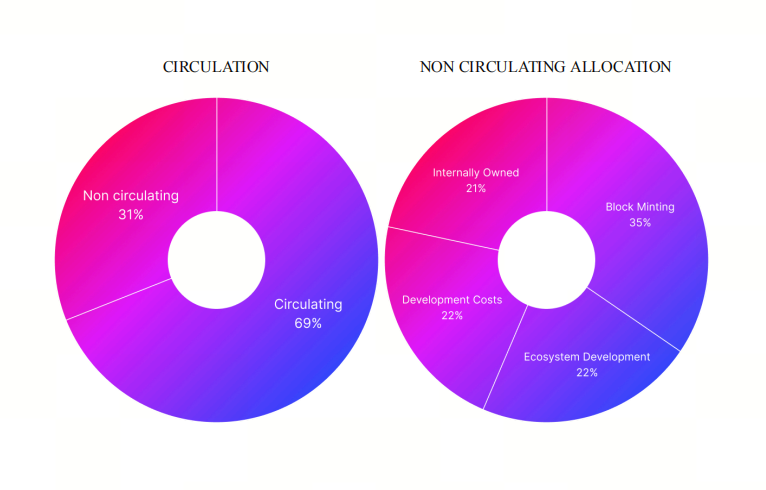 Image source: WEMIX White Paper
WEMIX is the native token of the WEMIX3.0 mainnet, serving as Gas, for node staking, governance voting, ecosystem incentives, and application settlement. On the supply side, the PMR mechanism mints 0.5 WEMIX per block, distributed in a 5:2.5:2.5 ratio to nodes, the ecosystem fund, and operations pool (Phase 2), channeling inflation directly into ecosystem growth.
At the node level, each NCP must stake at least 1.5 million WEMIX to be eligible for block production. From Phase 2, fixed staking is replaced by “competitive staking”—nodes can stake more to increase their share of rewards, but all NCPs retain equal governance voting rights, preventing dominance. Regular users can delegate WEMIX via Wonder Staking and share block rewards based on their chosen node’s fee rate.
On the demand side, WEMIX is used as the settlement asset for WEMIX PLAY, the transaction medium for WEMIX.Fi, and the governance credential for NILE. To offset inflation, the foundation began a multi-phase buyback in 2025: Phase 1 (March–April 2025) repurchased over 10 million WEMIX (about $7.5 million); Phase 2 expanded the buyback to 20 million WEMIX, with burning and incentive mechanisms to adjust circulation.
How WEMIX Differs from Other Gaming Public Chains
Within the broader “gaming public chain” landscape, WEMIX stands apart from Ronin, Immutable, Oasys, and Polygon in both positioning and approach. Ronin primarily serves Sky Mavis’s “Axie Infinity” and a few licensed games, focusing on deep single-IP operations. Immutable is closer to an “Ethereum sidechain + toolkit” model, offering zk-rollup and SDK services to third-party games.
Oasys, created by an Asian gaming consortium, uses a Layer 1 + Verse Layer 2 structure, favoring joint governance. Polygon is a general-purpose chain, attracting games through subsidies and partnerships, but lacks a unified publishing platform like WEMIX PLAY. WEMIX’s uniqueness lies in its vertical integration—led by a publicly listed gaming company, it forms a closed loop from the base chain, publishing platform, stablecoin, and DEX to payment channels, with proprietary IPs like “Legend of Mir,” “MIR4,” and “Night Crows” fueling ongoing content.
This “gaming company + public chain + full-stack ecosystem” model gives WEMIX unique advantages in user acquisition, content operations, and commercialization, but also ties its performance closely to single-company governance and Korean regulatory conditions—unlike general-purpose chains that decentralize risk through foundations or multi-party governance.
Risks and Market Controversies
WEMIX has faced two major delisting events in recent years, which are critical for risk assessment. In December 2022, Korea’s Digital Asset Exchange Alliance (DAXA)—comprising the five largest exchanges—delisted WEMIX, citing “actual circulation not matching official disclosure”: actual circulation stood at 318.4 million, about 30% higher than the 245.9 million officially disclosed, sparking serious information disclosure concerns.
On February 28, 2025, the Play Bridge Vault was hacked, resulting in the theft of 8.65 million WEMIX (approximately 9 billion KRW), but the official announcement came only on March 4—about five days later than industry norms—raising further concerns over transparency and security governance. DAXA subsequently terminated WEMIX trading on major Korean exchanges at 3:00 p.m. on June 2, 2025, causing prices to drop from around 1,350 KRW to 470 KRW, with Wemade’s share price plunging 17.28% in a single day.
Beyond these incidents, core market concerns include: lack of advanced security measures like multi-signature and real-time monitoring for core infrastructure, incomplete disclosure of risks related to WEMIX tokens as collateral for WEMIX$ stablecoin, and unclear compensation for affected users. For long-term investors, improvements in regulatory compliance, security audits, and disclosure will directly determine whether WEMIX can regain trust after its second delisting.
Future Directions and Potential
According to WEMIX Foundation CEO Kim Seok-hwan at the February 2026 Holders Town Hall, 2026 is a pivotal year for WEMIX’s global blockchain ambitions, with the strategy summarized as “gaming + payments + public chain upgrades.”
On the gaming front, WEMIX will maintain its “quality-first” publishing strategy, focusing IP and user growth on flagship projects like “Night Crows 2,” “MIR5,” and the global rollout of “Legend of YMIR Global,” while deepening partnerships with local publishers in emerging markets such as Southeast Asia. For payments, WEMIX Pay will evolve from a single in-game solution to a modular payment platform for third-party gaming and non-gaming sectors, using WEMIX$ and the WEMIX token for settlement across subscriptions, tipping, and cross-border payments.
On the public chain side, the WEMIX3.0 roadmap sets the Phase 3 goal: transitioning from SPoA to an open PoS model, where all stakers compete for validator slots, with the top 40 producing blocks—enhancing decentralization while maintaining high performance. Achieving this will determine whether WEMIX can shed its “centralized gaming chain” label and compete with Ronin, Immutable, and others on equal footing in the next Web3 cycle.
Summary
WEMIX stands out as one of the few Web3 projects with a publicly listed gaming company background, proprietary public chain, publishing platform, stablecoin, and payment channels. Its EVM-compatible WEMIX3.0 and 40-node SPoA consensus provide a solid foundation for high-frequency gaming. WEMIX PLAY, NILE, WEMIX.Fi, and WEMIX Pay together form a vertical value chain spanning content, finance, and payments.
However, the two delistings, bridge attacks, and disclosure controversies highlight the need for serious evaluation of governance, security, and compliance. For those interested in Web3 gaming, blockchain gaming infrastructure, and tokenomics, WEMIX is both a textbook “full-stack gaming public chain” and a real-world case study in how traditional gaming companies navigate the balance between compliance and decentralization.
FAQs
Q1: What is the relationship between WEMIX and Wemade?
Wemade is a publicly listed Korean gaming company and the primary initiator and strategic shareholder of the WEMIX public chain and ecosystem. WEMIX is the brand, public chain, and token system driving Wemade’s Web3 strategy, with the WEMIX Foundation overseeing ecosystem governance and operations.
Q2: What are the main use cases for WEMIX?
WEMIX is used for Gas payments, NCP and delegated staking, on-chain governance voting on the WEMIX3.0 mainnet, and as a settlement and incentive asset in applications like WEMIX PLAY, WEMIX.Fi, NILE, and WEMIX Pay—covering gaming, DeFi, NFT, and payments.
Q3: How does WEMIX3.0 differ from Ethereum?
WEMIX3.0 is an EVM-compatible Layer 1 maintained by 40 NCPs via SPoA consensus, with 1-second block times and up to 4,000 TPS, optimized for high-frequency gaming. It is positioned as a “dedicated gaming and ecosystem public chain,” rather than a general-purpose settlement layer.
Q4: Why was WEMIX delisted twice in Korea?
The first delisting in 2022 was due to a significant gap between actual and disclosed token circulation; the second in 2025 followed the theft of 8.65 million WEMIX from Play Bridge Vault in February and a five-day delay in official disclosure, exposing weaknesses in transparency and security governance.
Q5: How can regular users participate in the WEMIX ecosystem?
Users can play blockchain games on WEMIX PLAY, swap tokens and participate in liquidity mining on WEMIX.Fi, delegate staking via Wonder Staking to earn block rewards, or collect NFTs and participate in DAO governance on NILE. Before participating, users should fully understand the compliance requirements in Korea and their own region, as well as the project’s risk factors.