Unlike the traditional model in which "items and accounts ultimately belong to the operator," the WEMIX gaming ecosystem brings digital assets like equipment, skins, and currencies on-chain as tokens and NFTs, shifting ownership and usage rights from centralized servers to players' wallets. This transformation aligns with the Web3 industry's demand for "true ownership" and an "open economy," while also giving traditional MMORPG developers an unprecedented opportunity to connect multiple games, diverse participants, and global player communities through a unified on-chain economic model. By the end of 2025, WEMIX had aggregated more than 5.4 million registered users and over 3.8 million active on-chain wallets.
From an infrastructure standpoint, the WEMIX gaming ecosystem demonstrates a comprehensive "gaming public chain + full-stack application" paradigm: the foundational layer, WEMIX3.0, delivers high-frequency interaction capabilities of about 4,000 TPS and an EVM-compatible environment; the middle layer, WEMIX PLAY, acts as the traffic and publishing hub; and the application layer, with modules such as NILE, WEMIX.Fi, and WEMIX Pay, enables NFT circulation, token swap, and on-chain settlement. Game tokens, governance tokens, and stablecoins collectively form a composable on-chain economic layer, offering players, guilds, market makers, and developers diverse participation options and value capture channels.
The following sections systematically review the operational logic of the WEMIX gaming ecosystem from eight key perspectives: platform positioning, integration methods, P2E mechanism, NFT system, economic model, platform differentiation, industry challenges, and future roadmap.
What Is WEMIX PLAY
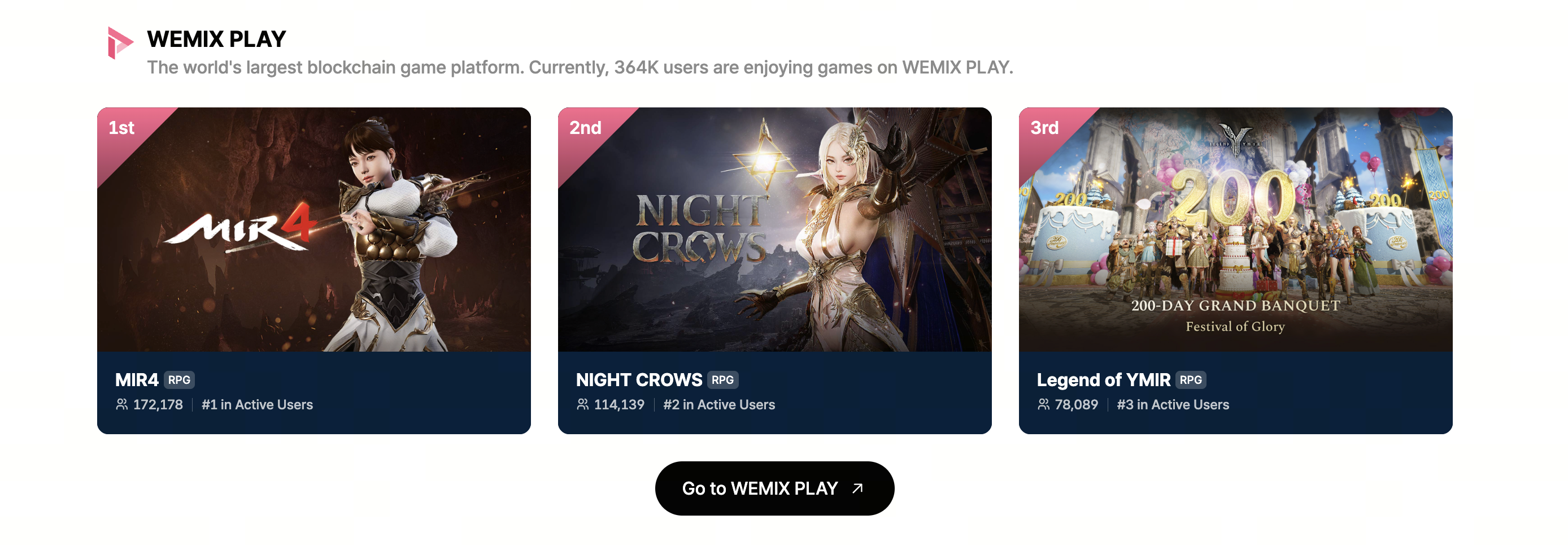
WEMIX PLAY is the unified publishing and portal platform of the WEMIX gaming ecosystem, positioned as the "Web3 version of Steam." It offers players game discovery, unified login, a built-in wallet, seasonal events, and services for token and NFT trading. As of early 2026, the platform had integrated more than 47 game projects, with cumulative active on-chain wallets exceeding 3.8 million and registered users surging from 417,000 in 2024 to over 5.42 million by the end of 2025—a year-over-year increase of about 1,200%.
On the technical front, WEMIX PLAY is built on WEMIX3.0 and leverages an Omni-chain architecture named "unagi" (Unbound Networking & Accelerating Growth Initiative), enabling a single game to share assets, identities, and leaderboard data across WEMIX3.0 and five external public chains. This extends a single-chain experience into a multi-chain, collaborative on-chain gaming network.
Commercially, WEMADE has established a $30 million gaming fund to invest in and support top-quality projects launching on WEMIX PLAY. By partnering strategically with overseas publishers like 101XP and Game Winner, the platform’s reach has expanded into Europe and Southeast Asia, while developers receive comprehensive support from testnet deployment through to global public launch.
How Blockchain Games Integrate with the WEMIX Ecosystem
Games integrate with the WEMIX ecosystem primarily through the WEMIX PLAY Developer Console and the official Technical Integration Guide. After project registration, developers can use the Console to apply for testnet resources, configure token and NFT contracts, upload game metadata, and conduct multiple rounds of joint debugging and security checks prior to launch.
From a technical perspective, WEMIX3.0 provides a full suite of APIs for dApps, including Account, Block, Contract, Transaction, Event Logs, and Tokens. Developers can directly leverage the EVM toolchain (Solidity, Hardhat, Foundry, etc.) for contract development without learning a new smart contract language. Combined with the SPoA consensus mechanism, which delivers about 1-second block times and up to 4,000 TPS throughput, WEMIX3.0 supports high-frequency on-chain interactions for MMORPG, SLG, and card games.
On the business side, WEMIX PLAY provides a unified wallet, single sign-on, player segmentation, and event templates, enabling developers to quickly access an "out-of-the-box" on-chain account system without building their own Web3 wallet infrastructure. NILE and WEMIX.Fi further offer NFT Marketplace and DEX liquidity, and together with the $30 million gaming fund, form a comprehensive integration solution spanning capital, technology, and distribution channels.
How the Play-to-Earn Model Works
The Play-to-Earn model in the WEMIX ecosystem follows a three-tier structure: "in-game materials → game tokens → universal tokens." Players earn rare materials or currency through quests, dungeons, and PvP, then mint these as on-chain game tokens according to protocol rules, and finally swap them on platforms like PNIX DEX and WEMIX.Fi for WEMIX, WEMIX$, or fiat-pegged assets, thus realizing value conversion.
For example, in "MIR4," players mine rare resources such as "Black Iron," exchange them at a fixed ratio for the game token DRACO, and then use DRACO for trading, minting NFT characters, or participating in Hydra staking within the ecosystem. The new-generation token EXDRA3 (EXD3), launched in December 2025, introduces a "daily swap limit of 2,000 and a weekly limit of 50,000," along with zero Gas fee swaps during specific events, to smooth out early inflation shocks.
"Night Crows" employs a more complex multi-token structure. Players earn vDIA (Value-added Diamond) through combat and gathering, then mint the main token CROW (maximum supply of 50 million) or any of nine functional tokens, including PAPYRUS, MORION, PROMOTE, GEAR, TEAR, FEATHER, ALLOY, and ESSENCE. All functional tokens are freely tradable on PNIX DEX, with independent market pricing for different gameplays.
Game Asset and NFT System Analysis
The NFT system in the WEMIX ecosystem is primarily managed by the NILE platform, covering game characters, equipment, land, and limited collectibles. NILE’s NFT Marketplace supports direct purchases, bidding (Offer), and auctions, charging a 2.5% platform trading fee per transaction. It also enables creator revenue sharing and additional on-chain royalties, allowing IP holders and original creators to continue earning from secondary market transactions.
From an ownership standpoint, all on-chain NFTs are directly linked to the player's wallet address and can be freely transferred within NILE or to external wallets, eliminating the risk of "asset loss due to account bans" seen in traditional games. In flagship titles like "MIR4," players can mint characters of a certain level and rarity as NFTs for sale, with buyers inheriting all stats and appearances—upgrading traditional "account trading" to protocol-level on-chain transactions.
In 2023, NILE also introduced NFTFi services, allowing players to use blue chip NFTs as collateral to borrow WEMIX or stablecoins. Due to market conditions and ecosystem restructuring, related Lend and Borrow services were suspended from May 4, 2025, with the platform refocusing on the NFT Marketplace and DAO governance. However, the underlying contracts and collateral logic remain in place for future high-net-worth NFT financialization scenarios.
Features of the WEMIX Game Economic Model
Compared to early "single-token P2E" projects, the WEMIX ecosystem adopts a "multi-token + rate limiting + stabilization mechanism" composite model. Night Crows uses 9–10 functional tokens to independently price rewards for combat, equipment, and social subsystems, preventing a single token from absorbing all inflationary pressure. CROW further introduces a Peg Stability Module (PSM), which temporarily restricts minting when the price falls below $0.75 and resumes it once prices recover, providing a stability anchor for gameplay tokens.
For issuance pacing, tokens like "MIR4" EXDRA3 typically set daily and weekly swap limits, combined with periodic events and quarterly updates, to control maximum release per time unit and mitigate "infinite farming" impacts on token prices. Simultaneously, liquidity pools on PNIX DEX and WEMIX.Fi provide authentic on-chain price discovery and market making, making tokens not just "game credits" but tradable assets with financial utility.
On the demand side, WEMIX and WEMIX serve as the two core assets. WEMIX is used for Gas fees, node staking, and governance, while WEMIX acts as a USD-pegged settlement unit for in-game purchases, trading fees, and stable settlement, insulating the game economy from full token price volatility. The foundation also implements multi-stage buyback plans, combined with token burns and ecosystem incentives, to adjust circulation and enhance long-term supply-demand balance.
Compared to platforms like Steam, App Store, and Google Play, WEMIX PLAY stands apart in asset ownership, revenue sharing, and cross-game composability. Traditional platforms only grant players "usage rights," with accounts, items, and currency ultimately controlled by the publisher or platform. In WEMIX PLAY, all on-chain assets belong to the player’s wallet, and neither the platform nor the game operator can unilaterally freeze or destroy them.
In terms of revenue structure, traditional publishing platforms typically take a 30% cut, making it difficult for developers to share commercial returns with players. The WEMIX ecosystem, through block rewards, token issuance, and buyback mechanisms, enables players, nodes, market makers, and developers to share in the token economy’s growth based on their contributions—realizing the logic that "user growth = protocol value" and, in theory, returning a larger share of revenue to content creators.
For ecosystem composability, players’ NFTs and tokens are no longer locked within a single game but can be resold on NILE, staked on WEMIX.Fi, or used in Wonder Staking. This "horizontal flow of on-chain assets" is a capability traditional centralized platforms cannot offer. However, players must also accept additional risks, including wallet private key management, market volatility, and regulatory uncertainty.
Challenges Facing Public Chain Gaming Ecosystems
Despite rapid growth, the WEMIX gaming ecosystem faces several structural challenges.
-
Sustainability of the economic model: Early P2E projects often suffered from persistent token inflation due to "play-to-mine," resulting in rapid valuation declines after player exits. WEMIX addresses this with multi-token, rate-limited swaps, and stabilization mechanisms, but whether token value and game activity can grow in sync over the long term remains to be validated by further data.
-
Compliance and regulation: South Korea has long imposed strict restrictions on in-game "cash rewards," forcing many WEMIX P2E products to operate overseas. Additionally, the two DAXA delisting events in December 2022 and June 2025 exposed deficiencies in WEMIX’s information disclosure, asset bridging security, and collateral transparency, leading to a short-term decline in ecosystem trust among some investors.
-
Industry competition and player demographics: Chains like Ronin, Immutable, Oasys, and Polygon have heavily invested in gaming, competing for a limited pool of top developers and native Web3 players. While WEMIX benefits from leading Korean game company backing and proprietary IP, it must continue to invest in brand recognition and multilingual localization for Western markets to expand from an "Asia-leading" position to true global competitiveness.
Future Development Directions for the WEMIX Gaming Ecosystem
According to the 2026 plans publicly disclosed by WEMADE and the WEMIX Foundation, the strategic focus for the next 1–2 years is "quality first + payment expansion + public chain upgrade." On the content side, the platform will concentrate resources on developing major MMORPGs such as "Night Crows 2" and "MIR5," and continue deep localization of "Legend of YMIR Global" in Southeast Asian markets like the Philippines and Indonesia, leveraging flagship products with high ARPU to strengthen ecosystem health.
On the payment side, WEMIX Pay transaction volume jumped from 1.75 million in the first half of 2025 to 17.02 million in the second half—a nearly tenfold increase. In 2026, WEMIX Pay is set to become a universal, modular payment solution for third-party games and non-gaming sectors, covering subscriptions, content tipping, and cross-border settlement, elevating WEMIX and WEMIX$ as practical on-chain settlement assets beyond in-game purchases.
For the public chain and infrastructure, the WEMIX3.0 roadmap outlines a Phase 3 objective: transitioning from the current SPoA model to an open PoS, where all stakers compete for validator roles based on holdings, with the top 40 nodes periodically selected to produce blocks. With continued Omni-chain expansion and pre-research into AI and gaming affiliate areas, the WEMIX gaming ecosystem is poised to evolve in the next Web3 cycle from a "blockchain gaming aggregation platform" to a "global on-chain gaming economy open to all players."
Summary
In summary, the WEMIX gaming ecosystem positions WEMIX PLAY as its traffic and publishing gateway, WEMIX3.0 as its foundational settlement network, and NILE and WEMIX.Fi as its NFT Marketplace and DeFi tools. Through a multi-token model, rate-limited swaps, and stabilization mechanisms, it has built a robust on-chain gaming economy. With 5.42 million registered users, more than 47 integrated games, and a $30 million gaming fund, WEMIX stands as one of the largest gaming public chain ecosystems in Asia.
At the same time, risks such as P2E model sustainability, local regulatory constraints, the repercussions of two delisting events, and international competition remain. For players, developers, and researchers interested in Web3 gaming, WEMIX is both a core case study of how traditional game companies fully embrace on-chain economics and a key reference for assessing the long-term viability of gaming public chains.